Despite the recent shifts in consumer behavior and the challenges posed by the changing political and economic conditions, the plant-based meat market growth trajectory is expected to continue. In fact, the slowdown in sales growth has provided a valuable opportunity for reflection, allowing the industry to reevaluate and strategize to ensure that it is fully prepared to meet the evolving needs of this dynamic market.
Our recent article on understanding the demand for plant-based meat highlighted the requirement for significant investments in expanding capacity. But the question remains:
How do we effectively scale up production capacity to match the most current market projections?
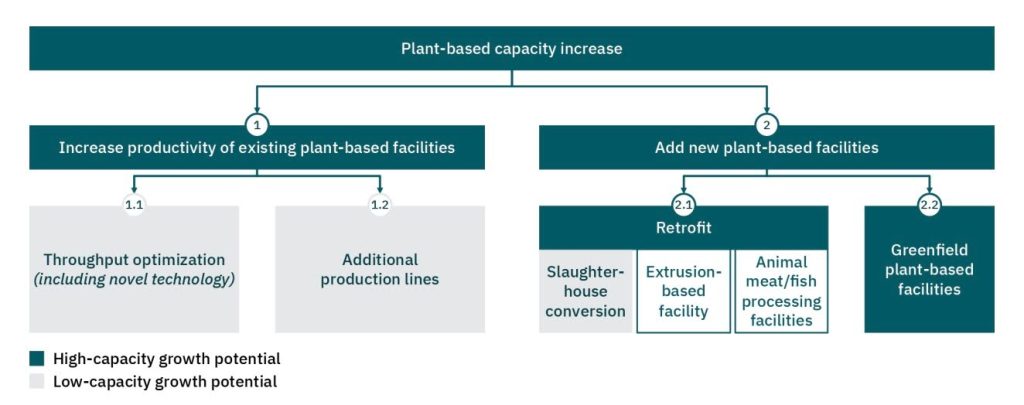
There are several potential pathways, including optimizing the productivity of existing plant-based meat producers or building new facilities. Based on insights from industry experts, existing facilities face constraints when it comes to expanding capacity. The options for increasing production are limited, whether through the addition of new production lines or by optimizing the throughput of existing lines; therefore, this article will concentrate on creating new plant-based facilities.
In particular, we’ll explore the choices between retrofitting and greenfield construction, determining their pros and cons. We’ll also identify industries with suitable spaces that can be transformed for plant-based production.
Two main options for capacity expansion
There are two main options to increase capacity: greenfield construction and retrofitting existing facilities from closely related industries.
1. Greenfield construction
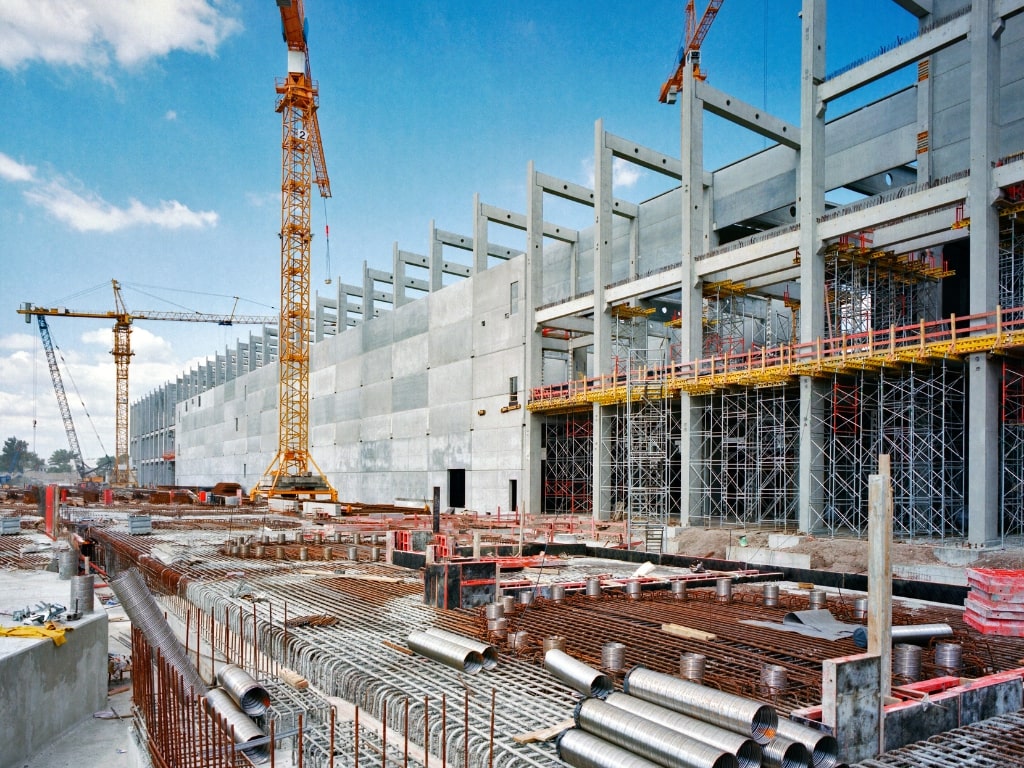
Greenfield construction refers to the creation of entirely new, custom-built facilities or production plants from scratch. These are usually built on previously undeveloped sites and allow for the integration of the latest technologies and production processes.
2. Retrofitting
Retrofitting refers to the transformation of existing facilities to accommodate the production of plant-based meat products. This approach repurposes structures originally designed for related industries. For example, the extrusion machinery used in pet food, pasta, breakfast cereals, and dry snacks industries can often be adapted without difficulty.
Animal food production is another parallel industry with suitable spaces for retrofitting. Facilities that can easily be transformed include animal meat/fish processing plants. On the other hand, while slaughterhouse buildings can be utilized with appropriate cleaning and layout adjustments, the equipment is typically unsuitable for use in plant-based product manufacturing.
Understanding the broader trade-offs of retrofitting versus greenfield for plant-based meat production
When it comes to expanding plant-based meat production capacity, the choice between retrofitting and greenfield construction isn’t just about bricks and mortar; it’s a complex web of trade-offs that can significantly impact your objectives.
Here’s a closer look at the trade-offs that require consideration before making the decision:
CapEx requirements
In order to make strategic decisions to scale up production capacity effectively, it’s crucial to consider capital expenditure (CapEx) and the financial implications of both greenfield and retrofitting approaches.
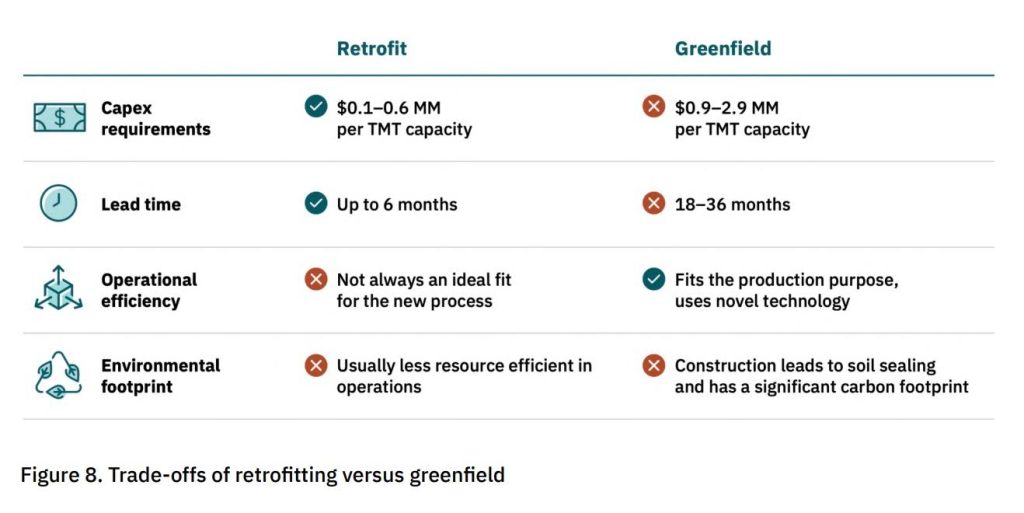
The greenfield approach typically involves higher CapEx as it requires the construction of an entirely new facility. Costs include land acquisition, design and engineering, construction materials, equipment purchase, and installation, which will be in the range of $0.9 to $2.9 million per thousand metric tons (M/TMT) of capacity.
On the other hand, retrofitting focuses on repurposing existing facilities and considers costs associated with equipment upgrades, layout adjustments, and ensuring safety compliance. The typical CapEx for retrofitting ranges between $0.1 and $0.6 M/TMT of capacity, depending on the extent of modifications and the condition of the facility – this calculation excludes land costs and the potential expenses related to facility acquisition, as these will vary widely by facility, region, and market.
Usually, minimal adjustments to a suitable facility are adequate for plant-based production, which demonstrates the clear advantage of retrofitting in terms of CapEx requirements.
Lead time
Shorter lead times offer advantages in terms of time to market, operational efficiency, cost control, and responsiveness to market conditions. On the other hand, longer lead times can result in delays, increased costs, and missed opportunities in a rapidly growing industry.
Lead time, for both greenfield and retrofitting, includes the amount of time from the binding investment decision to reaching full operations.
Once again, retrofitting has a clear advantage in this regard. The lead time can vary from a few weeks (involving thorough facility cleaning and procurement of ingredients and materials) to several months (including tasks like equipment upgrades, warehouse enhancements, building renovations to comply with food safety standards, and piping adjustments). Many parallel industries also share similar supply chains, allowing retrofitted facilities to make use of existing wider infrastructure.
In contrast, greenfield facilities, depending on permitting and construction speed variations across regions, can take anywhere from 18 months to three years to complete.
Operational efficiency
When assessing operational expenditure for every thousand metric tons (TMT) of product, it’s essential to factor in expenses related to ingredients, packaging materials, utilities, labor, and equipment maintenance needed to operate a facility.
Since greenfield facilities are custom-made for the plant-based production process, they typically incorporate the latest, most efficient technologies. As a result, operational efficiency is consistently higher in greenfield facilities compared to retrofitted ones. This is particularly true when a facility focuses on producing one type of product in large quantities, instead of managing various product types or variations.
Environmental footprint
When assessing the environmental footprint of a facility, it’s important to consider both the short and long-term impacts. This includes the total amount of greenhouse gas emissions, water usage, soil pollution, and other adverse effects directly or indirectly caused by facility retrofitting or greenfield construction.
Greenfield facilities are typically more environmentally sustainable in terms of energy use because they implement efficient processes and modern technologies like heat pumps, solar thermal heating, onsite photovoltaics, and improved insulation. These technologies often include automated cleaning processes and water treatment systems, reducing wastewater. However, the actual construction of a greenfield facility can contribute to soil sealing. Moreover, both the building materials and new production equipment can have a significant carbon footprint.
Due to the unique features and locations of each facility, it’s challenging to make a direct comparison between the environmental impact of greenfield versus retrofit. Therefore, the environmental trade-offs in each case must be evaluated by examining the specific characteristics of the facilities involved.
Which solution is better?
In summary, if there’s an existing facility suitable for adaptation, it minimizes the need for new and expensive construction and equipment. Consequently, the retrofit approach becomes an attractive choice for those seeking swift results with minimal initial investments.
Conversely, the greenfield approach is preferable when the focus is on achieving highly efficient, large-scale production of consistent products. Custom-designed, state-of-the-art equipment and optimized production processes facilitate the cost-effective scaling of substantial product quantities while reducing operational complexity.
Deep dive into pathways for expansion
Bright Green Partners recently collaborated with Good Food Institute to directly address the challenge of expanding plant-based meat capacity. Our insightful study quantifies the current global manufacturing capacity and also offers practical solutions for governments and businesses to bridge the gap and efficiently fulfill the growing demand.
Furthermore, the study explores the retrofit and greenfield approaches in further detail, offering valuable insights and scenarios that illustrate their advantages and disadvantages.
You can access the study here.
Additionally, reach out to us if you’re interested in learning more about how we support organizations in the plant-based industry, including business strategy, conceptual design and engineering, and techno-economic assessment.